YUM proposes stronger SME support, faster public-sector delivery, anti-corruption reforms, productivity incentives and an ASEAN-focused growth strategy as Malaysia prepares for a more uncertain global economy
KUALA LUMPUR, 7 SEPTEMBER 2026, As Malaysia prepares for Budget 2027, Yayasan Usahawan Malaysia (YUM) believes the coming national budget must go beyond annual allocations and become a decisive economic blueprint for strengthening entrepreneurship, productivity, investor confidence and Malaysia’s regional competitiveness.
Malaysia enters the Budget 2027 period from a position of relative strength. The economy expanded by 6.0% in the second quarter of 2026, following 5.4% growth in the first quarter, bringing first-half growth to 5.7%. Bank Negara Malaysia now expects full-year 2026 growth to be around 5%.
Inflation also remains relatively contained, with headline inflation at 1.8% in July 2026, while Bank Negara expects inflation to average between 1.5% and 2.5% for the year.
Malaysia’s external position has been particularly encouraging. For January to July 2026, total trade reached a record RM2.16 trillion, exports rose 29.2% to RM1.165 trillion, while the trade surplus increased to RM170.5 billion.
Investor confidence has likewise remained strong. Malaysia recorded RM218.5 billion in approved investments during the first half of 2026, 11.7% higher year-on-year, involving 2,746 projects expected to create more than 99,000 jobs. Foreign investment accounted for RM126.9 billion of the total.
For YUM, these figures demonstrate that Malaysia has momentum. The challenge for Budget 2027 is to ensure that this momentum translates into greater opportunities for Malaysian businesses, higher household incomes, more productive enterprises and stronger confidence in our institutions.
Chairman’s Statement
Datuk Nitesh Malani, Chairman of Yayasan Usahawan Malaysia, said:
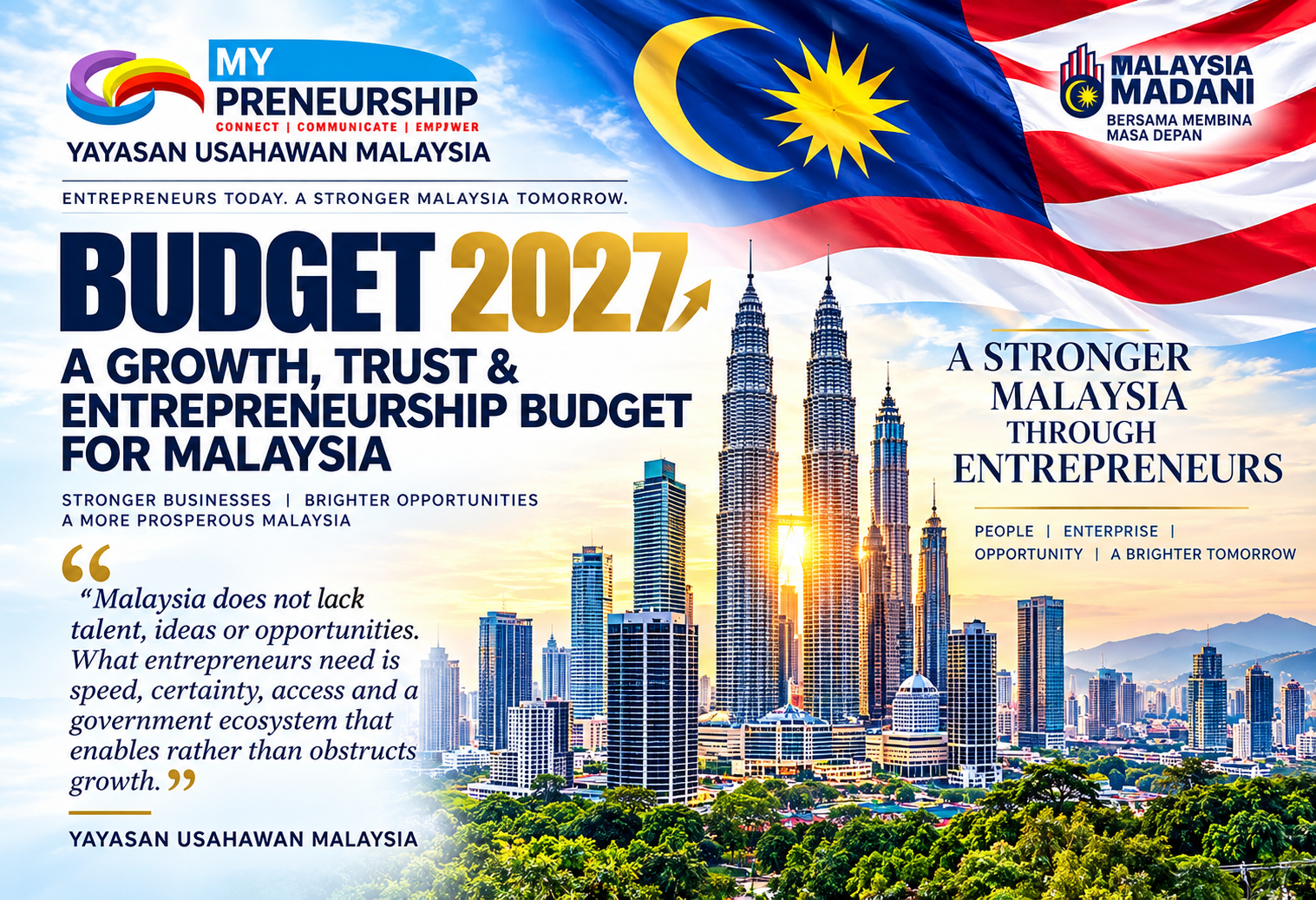
“Budget 2027 should not merely ask how much government can spend. It should ask how every ringgit spent can unlock another ringgit of private investment, create another Malaysian entrepreneur, raise productivity and strengthen confidence in our country. Malaysia does not lack talent, ideas or opportunities. What entrepreneurs need is speed, certainty, access and a government ecosystem that enables rather than obstructs growth.”
He added:
“Our next phase of national development must be built around three currencies that investors value enormously, trust, predictability and efficiency. When corruption is reduced, approvals are accelerated and public institutions become more accountable, Malaysia immediately becomes a more competitive place to invest, operate and expand.”
YUM’S BUDGET 2027 WISH LIST
YUM proposes a comprehensive 15-point Entrepreneurship and Competitiveness Agenda for consideration in Budget 2027.
- Make SME and Entrepreneur Growth a National Economic KPI
SMEs should not simply be treated as recipients of grants or assistance. They should be viewed as engines of national productivity.
Budget 2027 should establish clear national targets covering SME productivity, digitalization, export participation, automation, wage growth and the number of Malaysian companies progressing from micro to small, small to medium, and medium to regional enterprises.
Government assistance should increasingly reward measurable growth outcomes rather than programme participation.
- Establish a National SME Transformation Fund
YUM proposes a dedicated multi-year facility supporting businesses investing in:
-
- digital transformation and AI;
- automation and robotics;
- cybersecurity;
- cloud and data infrastructure;
- productivity systems;
- energy efficiency;
- sustainability and ESG readiness;
- intellectual property;
- e-commerce and export capability.
The objective should be transformation rather than temporary financial relief.
- Create a “Malaysia Scale-Up Programme”
Malaysia has many start-ups and SMEs but comparatively fewer companies successfully progressing into major regional businesses.
Budget 2027 should establish a structured programme for high-potential Malaysian companies with revenue, governance and export-readiness criteria.
Selected companies could receive coordinated support from MIDA, MATRADE, SME Corp, financial institutions and relevant ministries to expand across ASEAN.
We must start creating more Malaysian regional champions.
- Faster Government Approvals, Introduce an SME Service-Level Guarantee
Time is money for entrepreneurs.
Business licenses, planning approvals, regulatory approvals, permits and government certifications should have clearly published processing times.
YUM proposes a National Business Approval Service Charter, with measurable turnaround times for agencies dealing directly with businesses.
Where possible, approvals should become digital, interoperable and trackable through a single dashboard.
Malaysia should eventually move towards the principle of:
“Submit once, government shares the data internally.”
Businesses should not repeatedly submit the same corporate documents to different agencies.
SUPPORTING THE PRIME MINISTER’S GOVERNANCE REFORM AGENDA
YUM strongly supports Prime Minister Datuk Seri Anwar Ibrahim’s emphasis on stronger governance, eliminating corruption and improving the effectiveness of government delivery.
The Prime Minister has repeatedly stressed that investor confidence rests upon credible institutions, accountability and consistent enforcement, while the 13th Malaysia Plan also prioritizes reducing regulatory burdens on businesses and strengthening public-sector efficiency.
Just yesterday, the Prime Minister reiterated that investigations involving governance issues should be viewed through the principle of the rule of law rather than political considerations.
YUM believes this agenda has direct economic consequences.
Corruption is ultimately a tax on entrepreneurship. Bureaucratic delay is also an economic cost.
Every unnecessary approval, unexplained delay, duplicated requirement or opaque procurement process increases the cost of doing business.
- Introduce a National Ease-of-Doing-Business War Room
YUM proposes a permanent multi-agency task force chaired at a sufficiently senior level to identify and eliminate regulations that unnecessarily delay investment and business activity.
Its performance should be published annually.
Malaysia should establish targets for:
- company registration;
- construction approvals;
- local authority permits;
- investment approvals;
- customs clearance;
- expatriate specialist approvals;
- government procurement;
- business licensing.
What gets measured gets improved.
- Deepen Anti-Corruption and Procurement Transparency
YUM supports continuing institutional reforms that reduce leakages and increase confidence in public expenditure.
The implementation of the Government Procurement Act and greater digital transparency in government contracting should continue.
The Government’s 2026 fiscal strategy already targets a narrowing of the fiscal deficit to 3.5% of GDP, with a medium-term objective of 3% by 2028. Better procurement and reduced leakages can help protect development spending while strengthening fiscal discipline.
MAKING FINANCING WORK FOR ENTREPRENEURS
- Improve Access to Working Capital
Many viable SMEs remain constrained not by lack of orders but by working-capital limitations.
Budget 2027 should expand government-backed guarantee schemes for:
- contract financing;
- invoice financing;
- export financing;
- equipment financing;
- working capital;
- digitalization investment.
Credit assessments should increasingly incorporate business cash flow, transaction history and digital accounting records rather than relying primarily on traditional collateral.
- Introduce Faster Payment Standards
Delayed payment can destroy otherwise healthy SMEs.
YUM proposes that government ministries, agencies and GLCs adopt a 30-day payment standard for approved SME invoices wherever practicable.
This should gradually become a recognized national responsible-procurement benchmark.
- Incentivize Malaysian Companies to Buy Malaysian
Budget 2027 should encourage corporations, GLCs and government procurement programmes to develop qualified Malaysian suppliers.
However, localization should not mean accepting lower standards.
The goal must be:
Made by Malaysia, competitive with the world.
PRODUCTIVITY, TALENT AND WAGES
- Link Wage Growth to Productivity Growth
Malaysia cannot sustainably increase wages simply through regulation.
Higher wages must increasingly come from higher productivity, technology adoption and higher-value businesses.
Budget 2027 should therefore provide enhanced tax deductions or matching incentives to SMEs that simultaneously:
- automate operations;
- train employees;
- implement digital systems; and
- raise employee compensation.
This creates a virtuous cycle between business productivity and household incomes.
- Launch a National Entrepreneur Skills Wallet
Every Malaysian entrepreneur should have access to accredited training in areas including:
AI, finance, sales, digital marketing, exports, cybersecurity, leadership, governance and sustainability.
Government-supported training should increasingly be linked to measurable business outcomes.
- Encourage Entrepreneurship Among Youth
Universities and TVET institutions should become centres of enterprise creation rather than simply employment preparation.
Budget 2027 could establish entrepreneurship grants and structured mentorship for graduates capable of building commercially viable businesses.
MALAYSIA AND ASEAN IN A CHANGING GLOBAL ECONOMY
The international environment confronting Malaysia in 2027 and 2028 will remain challenging.
The IMF currently projects global growth of 3.0% in 2026 and 3.4% in 2027, while Emerging and Developing Asia is expected to outperform the global economy, expanding around 5.0% in 2026 and 4.8% in 2027.
However, substantial uncertainties remain.
Geopolitical conflict, energy-price volatility, tariff disputes, supply-chain fragmentation, financial-market repricing and uneven global inflation all present risks. At the same time, an extraordinary global technology investment cycle driven by semiconductors, data centres and artificial intelligence is creating major opportunities for economies embedded within the Asian technology supply chain.
Malaysia is particularly well positioned because of its strong E&E ecosystem, ASEAN connectivity, sophisticated financial system, multilingual workforce and established manufacturing base.
- Build an ASEAN First Growth Strategy
Budget 2027 should provide stronger incentives for Malaysian SMEs expanding into ASEAN.
Support should include:
- market-entry grants;
- export insurance;
- regional distribution support;
- cross-border digital commerce;
- ASEAN regulatory advisory services;
- trade missions;
- international branding assistance.
ASEAN’s growing consumer base should increasingly become the domestic extended marketplace of Malaysian companies.
- Position Malaysia at the Centre of the AI and Technology Economy
Malaysia should aggressively capture opportunities in:
semiconductors, AI infrastructure, cloud computing, data centres, cybersecurity, advanced manufacturing, health technology, clean technology and digital services.
The objective should not only be attracting multinational investment.
Malaysia must ensure that Malaysian SMEs become suppliers, technology partners and intellectual-property owners within these ecosystems.
- Create a National SME Resilience Framework
The next global shock may come from geopolitics, energy, cyber threats, climate disruption or another unexpected source.
Budget 2027 should introduce incentives for SMEs to develop:
- business continuity plans;
- cybersecurity protection;
- supply-chain diversification;
- insurance coverage;
- energy resilience;
- financial contingency planning.
Resilience should become part of Malaysia’s national economic competitiveness strategy.
FROM APPROVED INVESTMENT TO MALAYSIAN ECONOMIC VALUE
Malaysia’s RM218.5 billion in approved investments during the first half of 2026 demonstrates strong confidence in the country.
The next question must be:
How much of that investment eventually flows into Malaysian companies, Malaysian workers, Malaysian intellectual property and Malaysian supply chains?
YUM proposes stronger mechanisms connecting multinational investors with qualified local SMEs.
Every major investment attracted to Malaysia should produce secondary economic opportunities through supplier development, technology transfer, skills development and domestic procurement.
COST OF LIVING: GROWING INCOME MUST BE PART OF THE SOLUTION
YUM recognizes that protecting households from rising living costs remains a central responsibility of government.
However, Malaysia cannot subsidize its way indefinitely towards prosperity.
Long-term cost-of-living resilience requires better jobs, stronger businesses and higher household incomes.
The ultimate objective should be to move Malaysians from receiving assistance towards increasing economic participation and earning capacity.
ASIA CAN OUTPERFORM — IF IT WORKS TOGETHER
The global economy is increasingly fragmenting into strategic economic blocs.
ASEAN and wider Asia therefore have an important opportunity.
Regional economies should strengthen intra-Asian trade, cross-border investment, digital connectivity, food security, energy cooperation and technology ecosystems.
Malaysia can play an important bridge between ASEAN, China, India, the Middle East and Western economies.
Datuk Nitesh added:
“The global economy of 2027 and 2028 will reward countries that can move quickly while remaining stable. Asia has demographics, manufacturing capability, capital and an extraordinary entrepreneurial culture. If ASEAN integrates deeper and Malaysia continues strengthening governance, technology and business competitiveness, there is every reason for our region to continue outperforming much of the global economy.”
A BUDGET THAT BUILDS CONFIDENCE
YUM believes Budget 2027 should ultimately be measured through five outcomes:
More entrepreneurs.
More productive Malaysian businesses.
Higher-value jobs.
Greater investor confidence.
And greater trust in our institutions.
Malaysia’s economic indicators provide reasons for confidence. GDP growth is strong, inflation remains manageable, exports are at record levels and investment approvals remain substantial.
But there can be no complacency.
Malaysia is competing every day for capital, talent, technology and business.
Budget 2027 therefore represents an opportunity to send an unmistakable signal:
Malaysia is open for enterprise, serious about reform and determined to build globally competitive Malaysian businesses.
Datuk Nitesh concluded:
“Entrepreneurs are not asking government to remove every risk. Risk is part of entrepreneurship. What we ask for is a level playing field, efficient institutions, access to opportunity and certainty in policy. Give Malaysian entrepreneurs that environment, and they will create the businesses, employment, innovation and wealth that will carry Malaysia into its next economic chapter.”
Issued by:
Yayasan Usahawan Malaysia (Entrepreneurship Foundation Malaysia)
Office of the Chairman